The High Courts Are In
By Aniruddha Sen4 August 2026
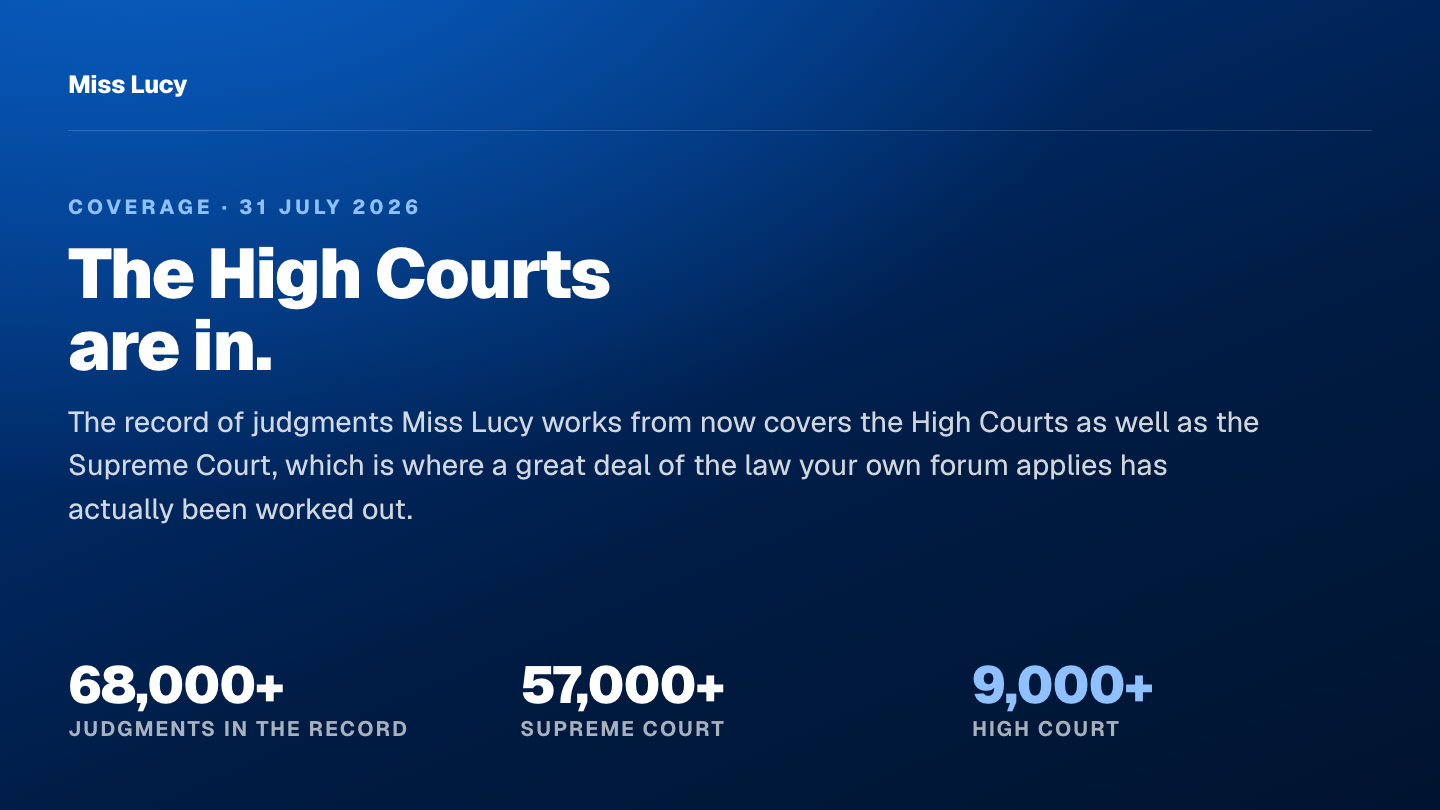
Since the 31st of July, the record of judgments Miss Lucy works from covers the High Courts as well as the Supreme Court. The record now holds more than 68,000 Indian judgments, of which more than 57,000 are Supreme Court decisions and more than 9,000 now come from the High Courts, and it is the second figure that matters here, because until a few days ago it was close to nothing. We built the Supreme Court side first, for the good reason that it is where a point of law is settled for the whole country, and the cost of building it in that order was that the answers she gave you were often one court away from the court you were actually standing in.
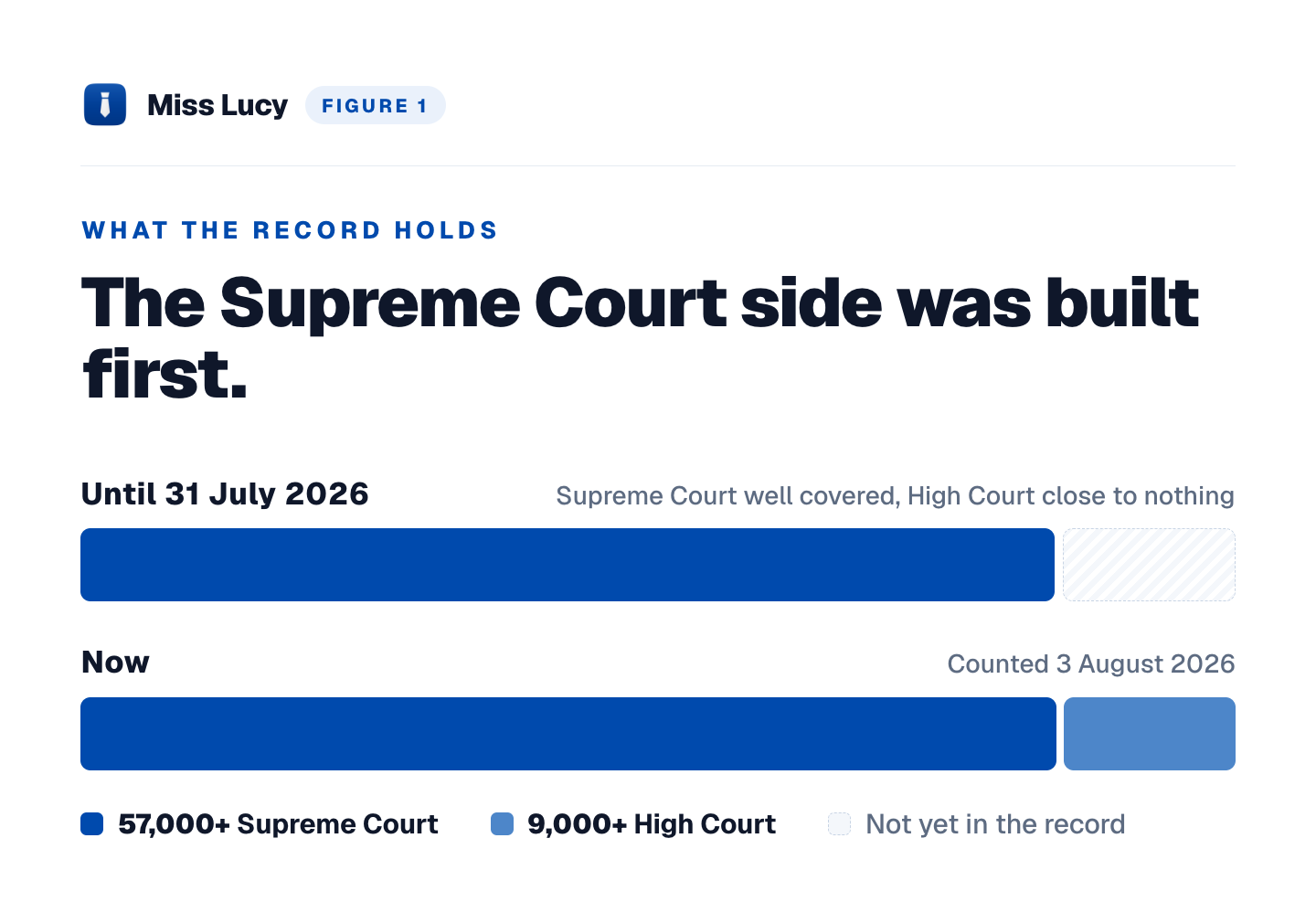
More than 68,000 judgments in the record in total, alongside 871 Central Acts. Coverage is not even across the High Courts — some courts are represented far better than others, and the collection grows every week.
The court that binds you is usually not the Supreme Court
Article 141 makes the law declared by the Supreme Court binding on every court in India, so that is where research on a point starts, and a collection that holds the Supreme Court well will get you the ratio. But think about what you actually read out when you are on your feet. If you are before a Single Judge of your own High Court, the thing that closes the argument is very often a Division Bench of that same High Court, because the judge is bound by it, whereas a judgment of a different High Court on the same section is persuasive at best and your opponent will say so before you have finished reading it out.
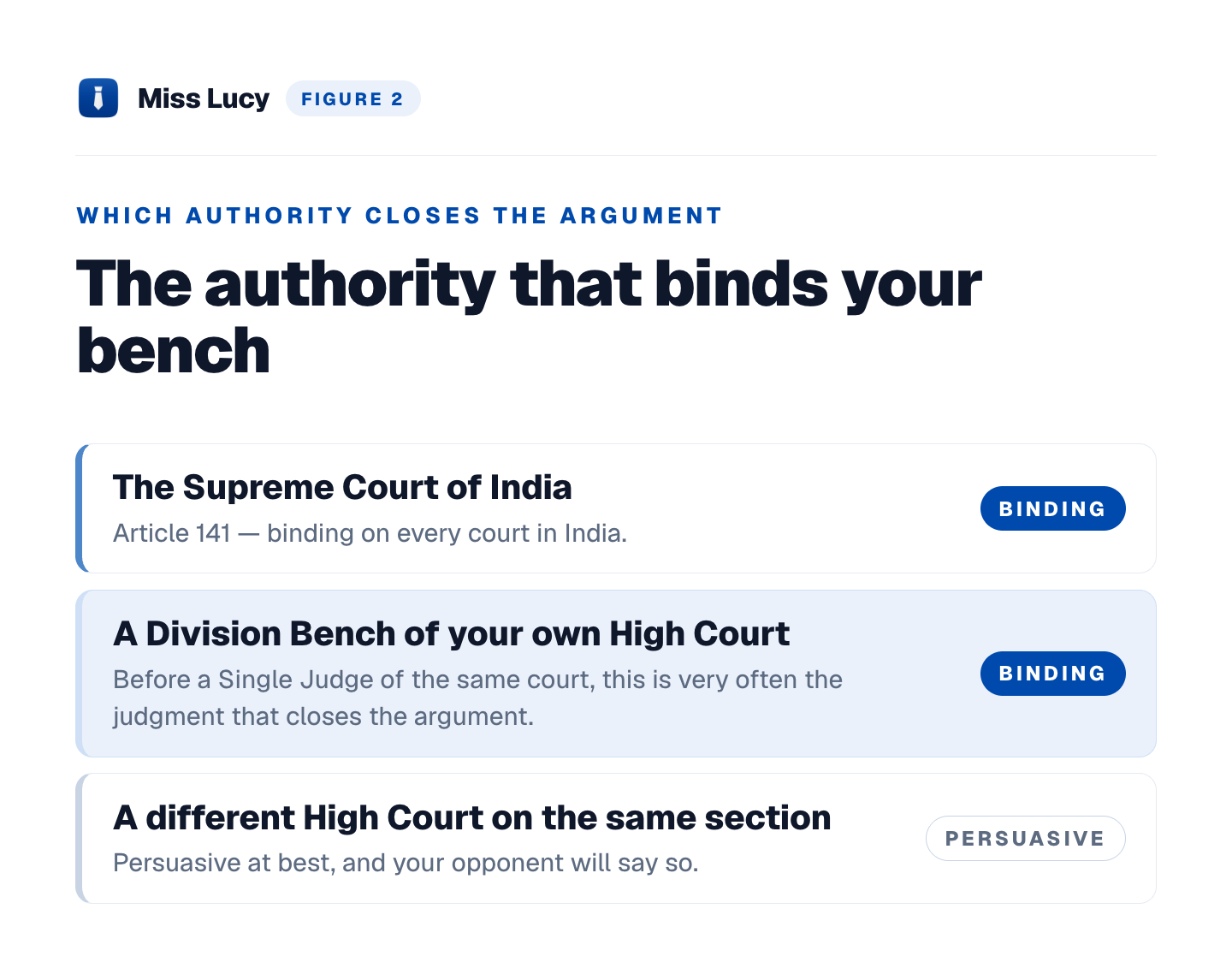
The middle tier is the one that used to be missing from the record, and it is the tier a great deal of service, tenancy, motor accident and criminal revisional work is actually decided on.
A great deal of Indian law is worked out in the High Courts and stays there. Service matters, tenancy and rent control, motor accident compensation, the everyday criminal revisional work — the Supreme Court has usually said something general about each, some years ago, and the working law of your forum has been built by your own court in the time since, decision on decision, and that is the law the bench in front of you applies on a Tuesday morning.
Where the afternoon actually goes
The Supreme Court authority is rarely the slow part. Half the time you knew it before the brief arrived, and finding it again takes a few minutes. The afternoon goes to everything after that: whether your High Court has applied that ratio and in what terms, whether a coordinate bench has taken a view you will have to distinguish before the other side raises it, whether there is a Full Bench that has already settled the question you were about to argue as an open one, and whether the paragraph you are relying on says what the headnote suggests it says. That work is jurisdictional, it is unglamorous, and it was the part we were leaving to you, because the judgments that answer it were not in the record she was reading from.
What changes in the daily work
You can now ask her what your own High Court has said on the point, and the answer comes from the judgments themselves rather than from a general impression of what courts tend to hold, with the court, the date and the paragraph she is relying on, and the judgment there to open and read, so that you check her the way you would check a junior — by reading the thing for yourself. Ask her whether the position in your High Court sits with the Supreme Court's, or whether another High Court has gone the other way, and she is working from the text of those decisions.
The test I care about is not whether she finds a case. It is whether the authority that ends up in the thing you file — the ground in the appeal memo, the paragraph of the written submission, the case you hand up — is one your forum is bound by rather than one it may merely consider. What she gives you is a draft you edit and case law you verify, and the judgment on both of those stays where it belongs, which is with you.
What this doesn't cover
Coverage is not even across the High Courts, and I am not going to pretend that it is. Some courts are represented far better than others at the moment, the collection grows every week, and where she does not have the decision you need she should tell you so plainly rather than fill the gap with something that has the right shape — the controls we built around citations exist for exactly that failure, and they apply here as they do everywhere else. The statutes side of the same record already carries 871 Central Acts, and the same widening is going on there, so that the section you are working from and the cases decided under it come from one place.
Try it on a matter you actually have
The honest test is a live file rather than a demonstration, so take a point you are researching this week, and one where you already know roughly what your High Court has held, because that is the way to catch her out if she is wrong. There are 2 free finished documents and unlimited questions, 10 days, no card.
I'm Ani, co-founder of Miss Lucy — India's first conversational legal intelligence partner. If you practise before a High Court and the research you do is mostly your own court's law rather than the Supreme Court's, this release was built for your week, and I'd like to know whether it holds up in it.