Teams Started as a Legal Product. Now We Run the Whole Back Office.
By Aniruddha Sen27 October 2026
Six weeks ago we put out a version of Miss Lucy called Teams. It was meant for in-house legal teams — a place for their matters, their documents, their registers, and a Miss Lucy to talk to about each of them. A decent enough product. But we kept tinkering with it, and somewhere along the way it morphed into something a lot, lot, lot more.
Today, Teams is an end-to-end service. We run a company's finance, accounting, legal and compliance, and nobody has to fiddle with software or computers. We take care of it all.
Here's how a month runs, because "managed service" can mean anything. The company's papers land in one secure folder — bank statements, bills, invoices, photos taken on a phone, Excel sheets, scans, the works. Our people and Miss Lucy's agents do everything after that. We keep the books, line by line, the right GST treatment, the right TDS section, and the same statement can never be booked twice. At the end of the month we compute GSTR-3B from the books and file it on the GST portal from the chat itself. The one-time password goes to the company's authorised person, it gets typed on a card, and the month locks exactly as filed. We keep the compliance register with every return, renewal and filing the company owes, and the court diary that reminds the lawyer before hearings. Every piece of work carries a checklist with a name and a date on each step, so the company can see who is holding what. We read the contracts and file the risks where the company can see them.
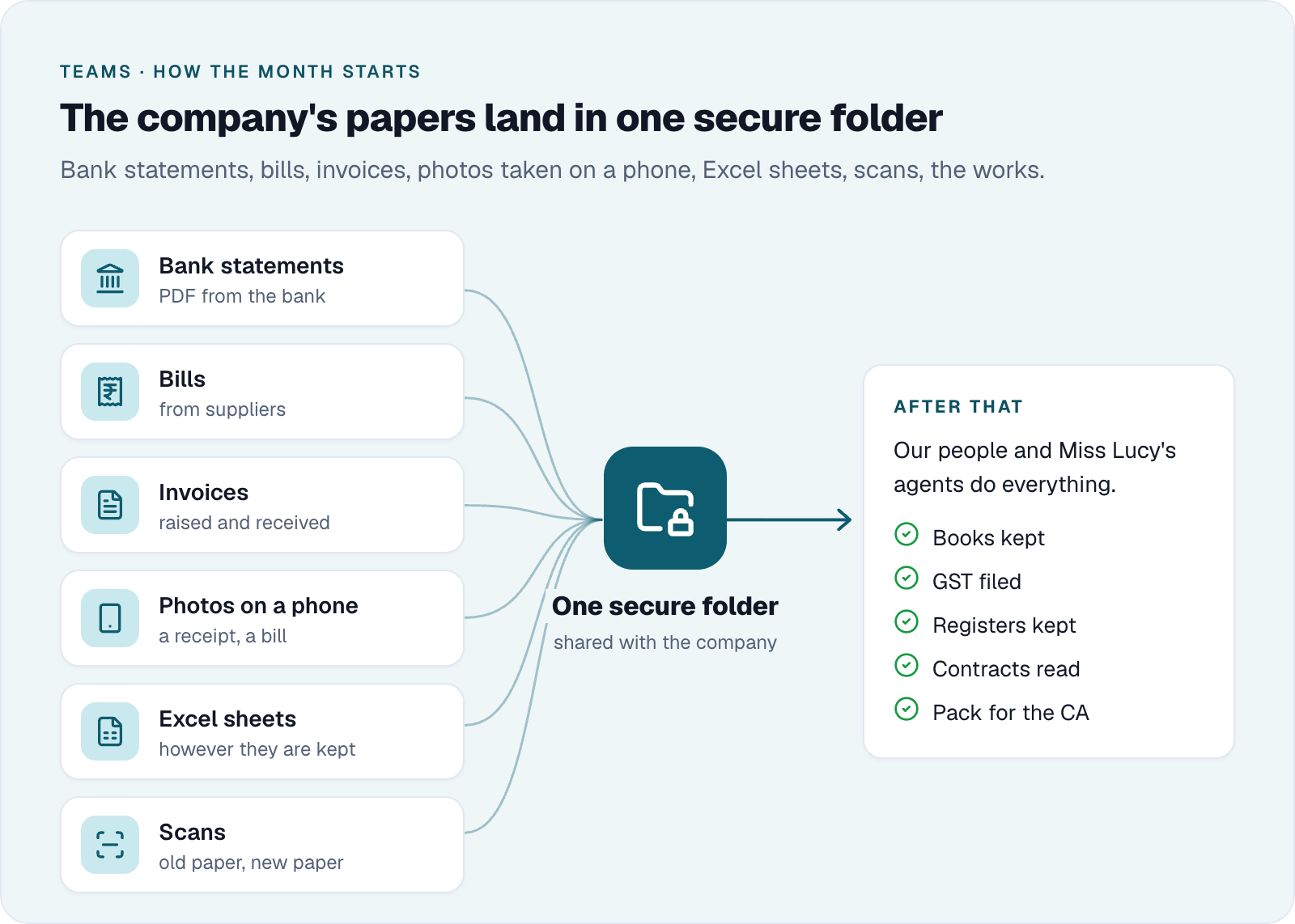
How the month starts. The company's papers land in one secure folder, and our people and Miss Lucy's agents do everything after that.
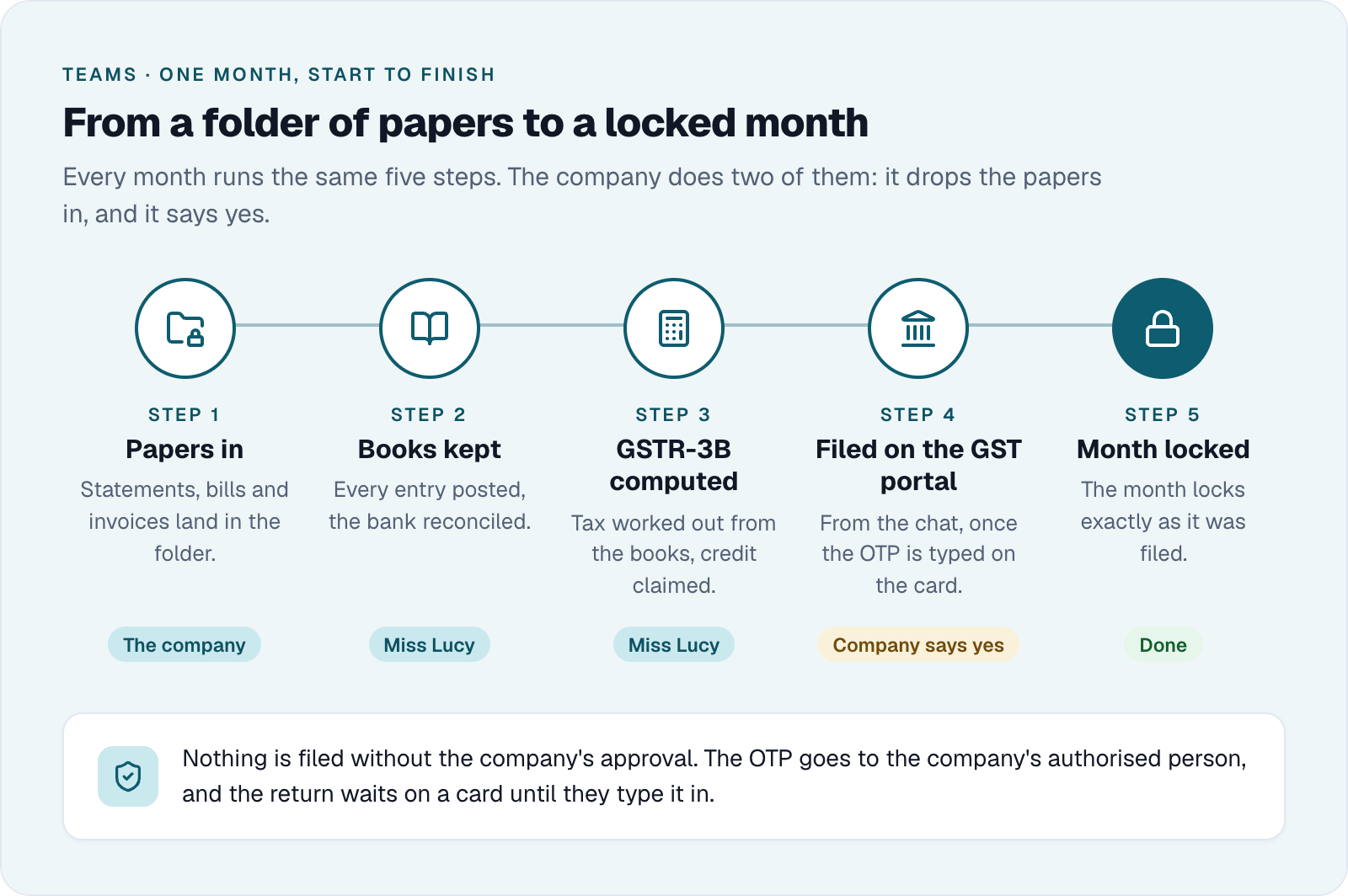
One month, start to finish. The company does two of the five steps: it drops the papers in, and it says yes.
When the CA or auditor asks for the quarter, they get the whole pack — ledger, trial balance, balance sheet, P&L — as Excel, PDF and Word. If a single ledger doesn't tie, the pack doesn't go out.
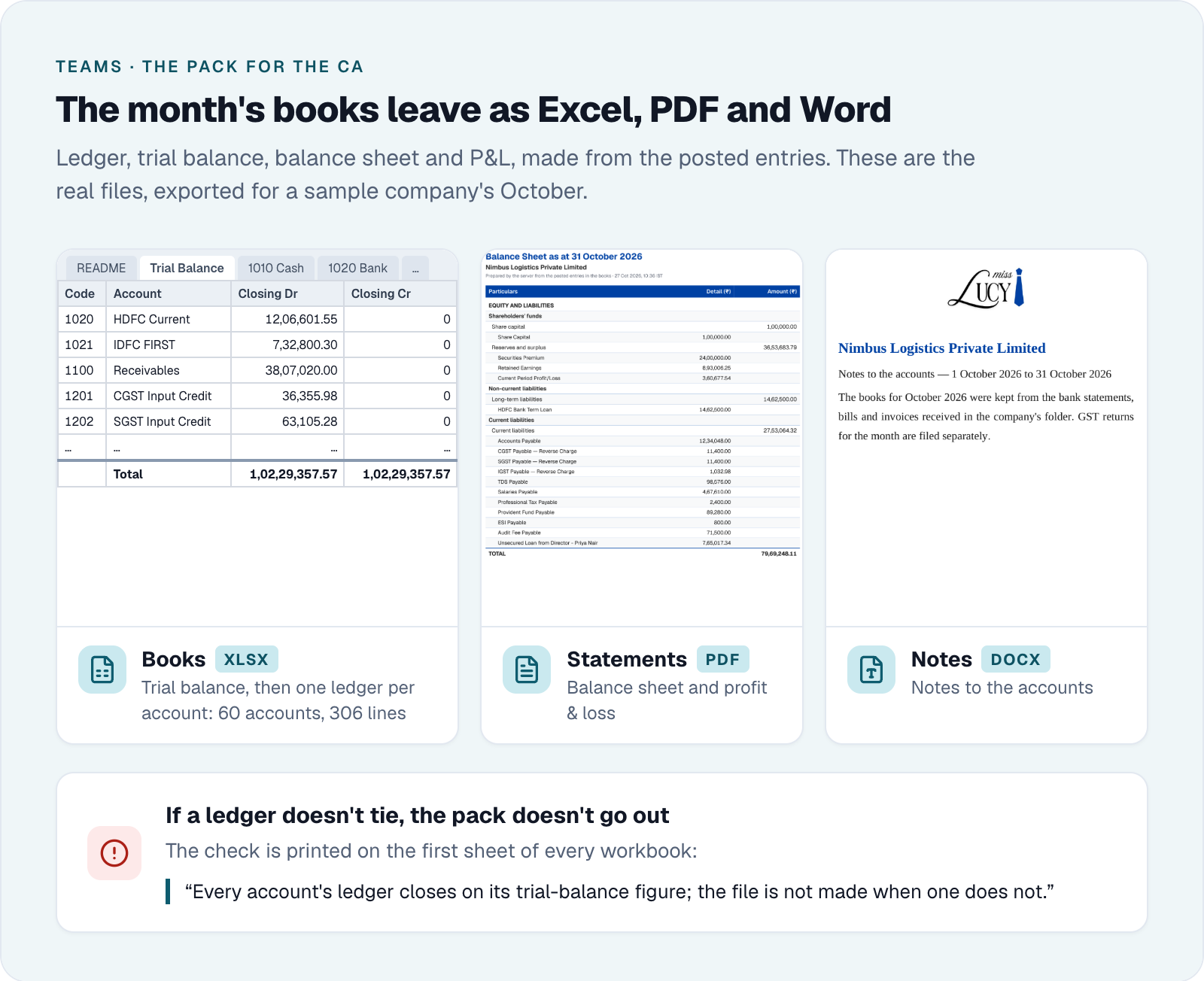
The pack for the CA, as the server exports it for a sample company's October: the books as Excel, the statements as PDF, the notes as Word. If a ledger doesn't tie, the pack doesn't go out.
Nothing irreversible happens without the company's yes. A filed return, a cancelled invoice, a closed year — each waits on a card until someone approves it. Everything else just happens, and the company hears about it after the fact.
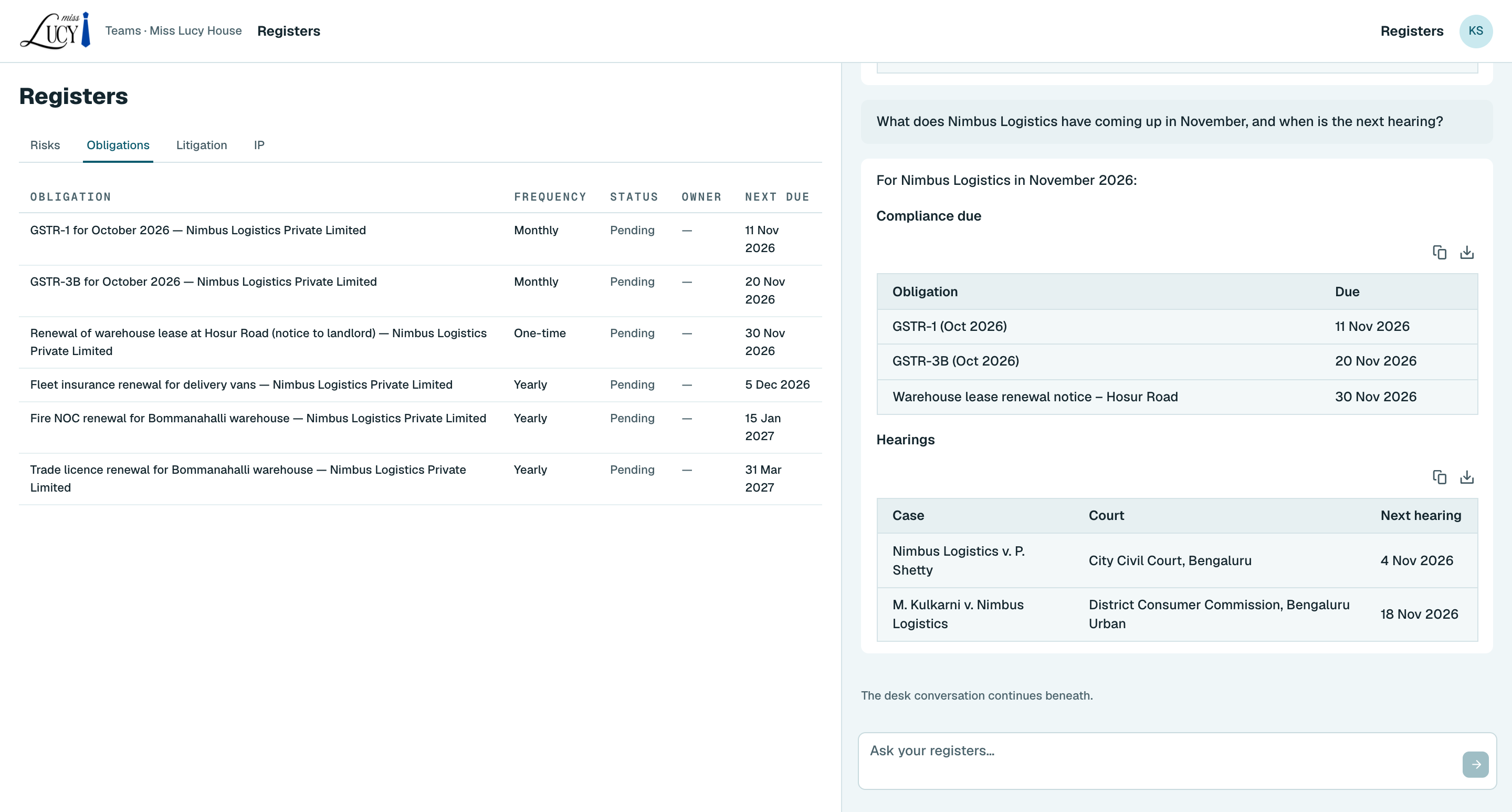
The compliance register and the court diary for a sample company, and the desk answering what is due in November.
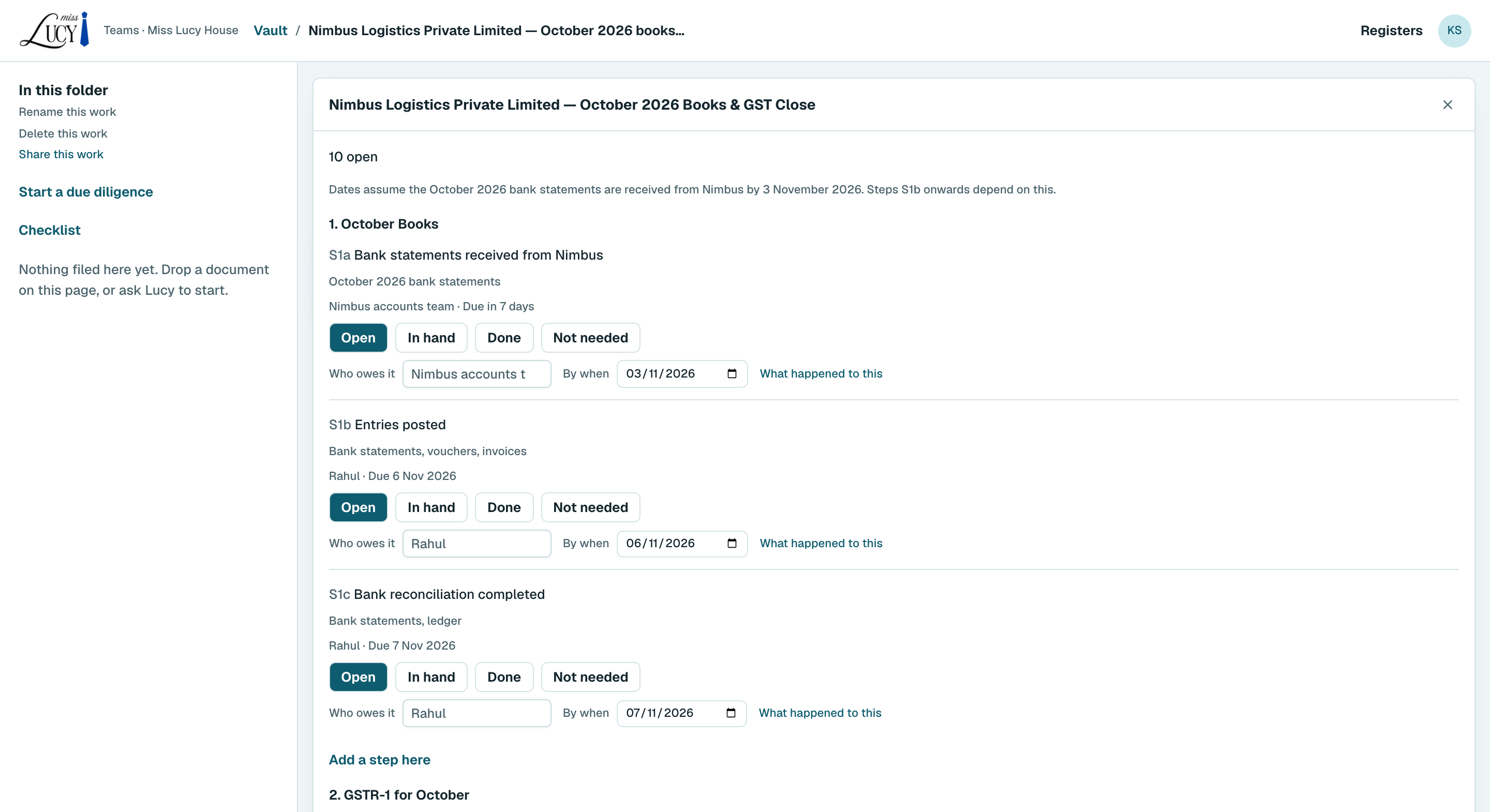
Every piece of work carries a checklist, with a name and a date on each step.

Inside one piece of work. The documents and the conversation are in the same place, and what is produced is filed there.
We worked out what two typical companies pay today for this exact work. A company doing about ₹3 crore in turnover, with twenty-odd people and no real departments, pays ₹12.7 lakh a year. An accountant on payroll, a CA firm on retainer, an auditor, a company secretary, a lawyer, and the software all of them type into. A company doing ₹30 crore, with a hundred and fifty people and its own finance and legal staff, pays ₹92.5 lakh a year.
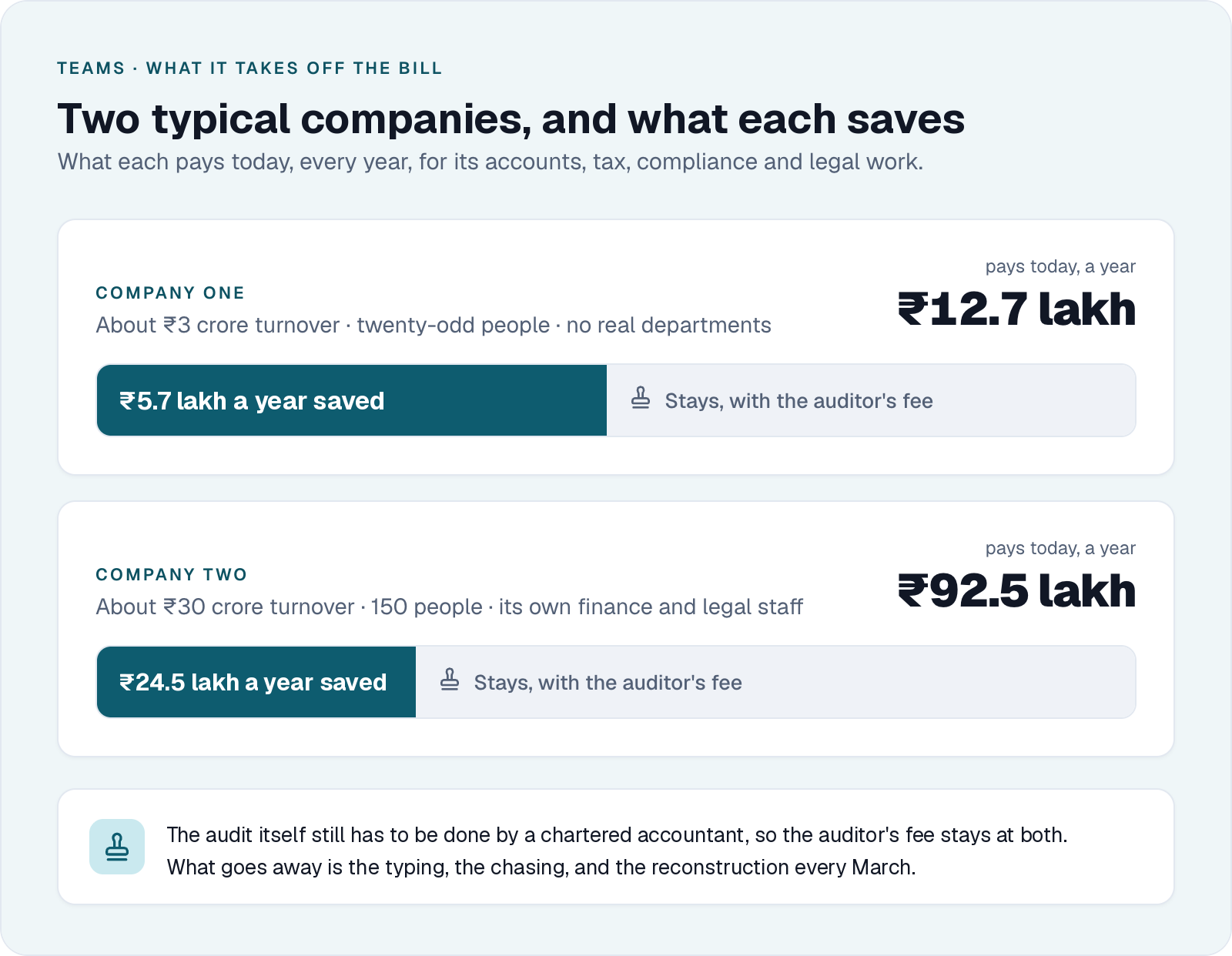
Two typical companies, what each pays today for this work, and what each saves with Teams. The auditor's fee stays at both.
Hand that work to Teams and the ₹3-crore company's bill comes down to about ₹7 lakh. That is ₹5.7 lakh a year saved. The ₹30-crore company's bill comes down to about ₹68 lakh. That is ₹24.5 lakh a year saved, plus a good chunk of the senior people's time. The audit itself still has to be done by a chartered accountant, so the auditor's fee stays. What goes away is the typing, the chasing, and the reconstruction every March.
I should say what we don't do, because I'd rather it came from me. No payroll. No TDS returns, no company ITR, no ROC filings, no court appearances, no company registrations, no trademark filings. The company's CA and auditor stay. We take the drudgery off their plates, and off the company's.
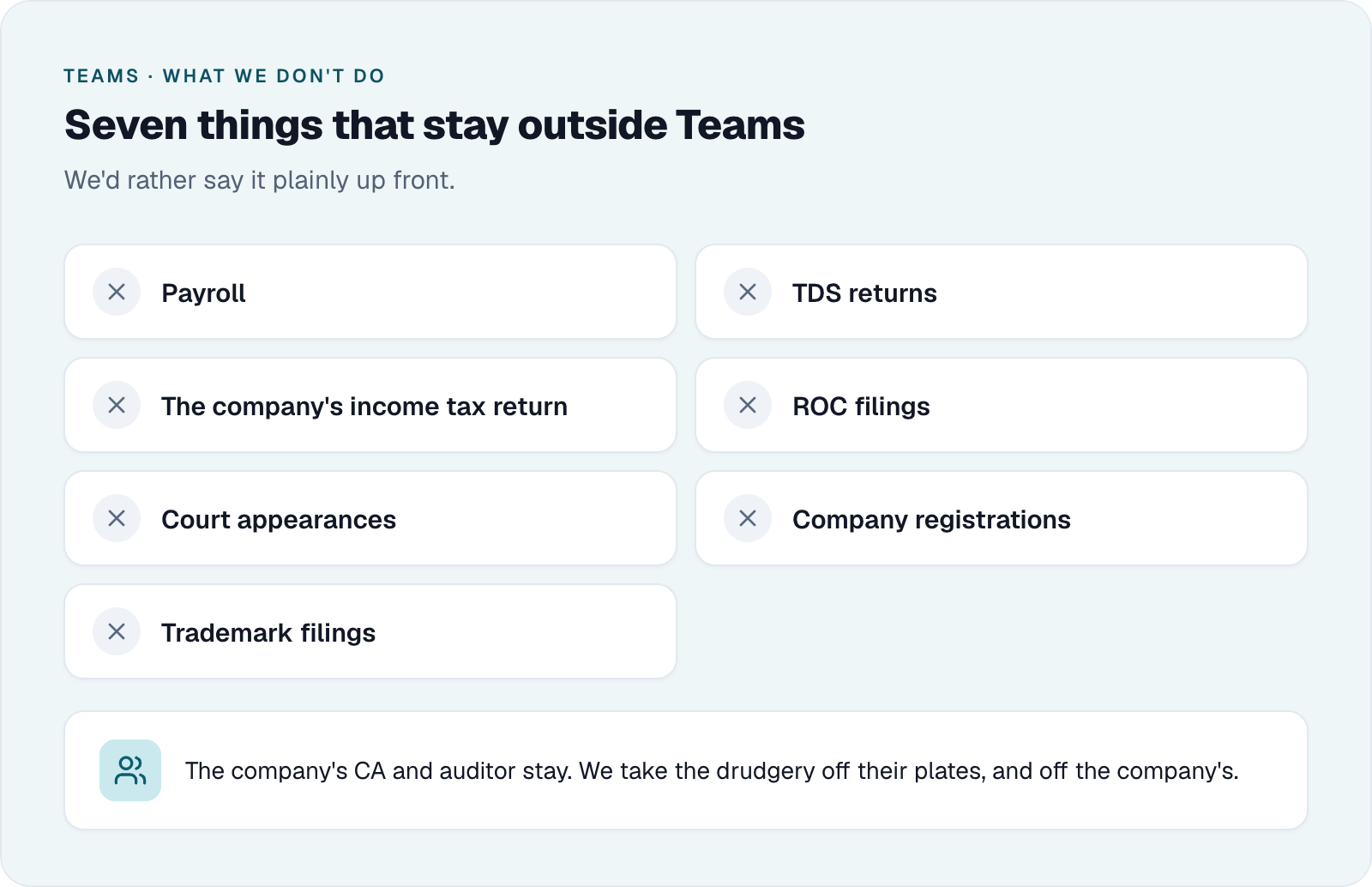
Seven things that stay outside Teams. The company's CA and auditor stay.
Teams isn't open on the site yet, and there's no price on it. We are setting each company up ourselves, on a walkthrough call, and I want to know what this work really costs us before I put a number on it. If you run a company's finance or legal, or a CA firm sitting on too many clients' books, leave your details at miss-lucy.in/teams. The company comes off the call with the books open and the compliance calendar loaded, and from then on its entire job is dropping papers in a folder and approving the odd card.
I'm Ani, co-founder of Miss Lucy.